


By Julius Nsikak
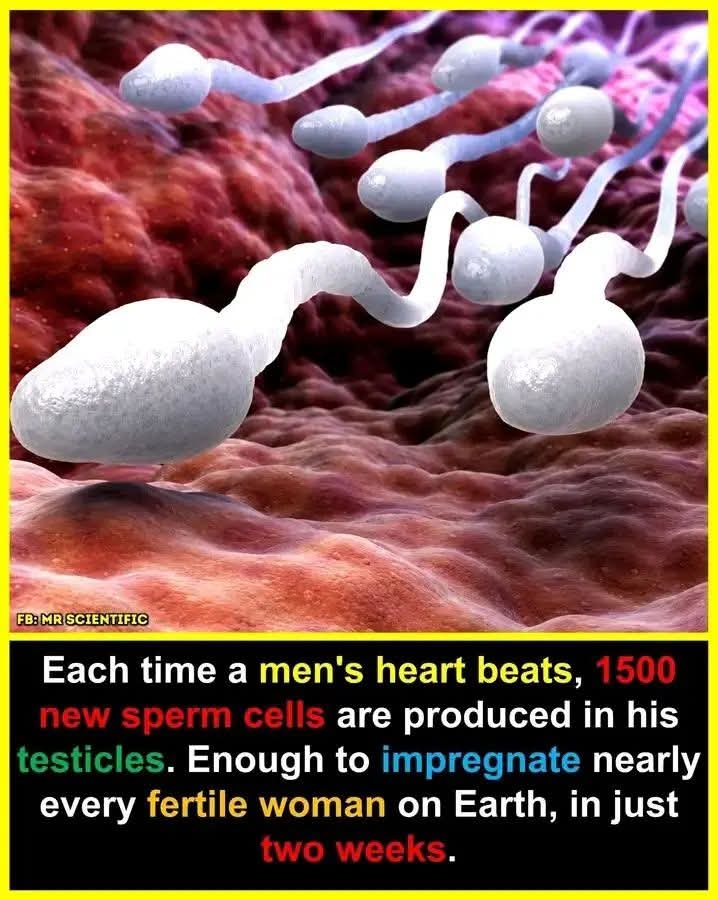
A viral social media graphic claims that every time a man’s heart beats, about 1,500 sperm cells are produced in his testicles and that within two weeks enough sperm could be generated to impregnate nearly every fertile woman on Earth. While the claim appears astonishing, scientific research shows that the reality is more nuanced than the graphic suggests.
Research published in the journal Human Reproduction found that healthy men produce millions of sperm cells each day. Scientists estimate that sperm production can range from approximately 1,000 to 1,500 sperm cells every second, depending on factors such as age, genetics, health status, nutrition and environmental conditions. Given an average heart rate of 60 to 100 beats per minute, the viral claim broadly reflects the remarkable scale of sperm production in the male reproductive system.
Sperm are produced in the seminiferous tubules of the testicles through a process known as spermatogenesis. This process begins at puberty and continues throughout a man’s reproductive life. However, contrary to what the graphic may imply, sperm are not created instantly with each heartbeat. Rather, each mature sperm cell is the product of a lengthy developmental process that takes approximately 64 to 74 days to complete.
According to reproductive health researchers, a healthy adult male may produce between 100 million and 300 million sperm cells daily. Over a period of two weeks, this can amount to billions of sperm cells. From a purely numerical perspective, the figure is indeed impressive and demonstrates the extraordinary efficiency of human reproductive biology.
However, experts caution that sperm quantity alone does not determine fertility. Studies show that many sperm cells never reach maturity, while others may have abnormalities affecting their movement, structure or genetic integrity. Even during ejaculation, only a fraction of sperm survive the journey through the female reproductive tract.
Research from fertility specialists indicates that successful conception depends on numerous biological factors. A woman must be within her fertile window, the sperm must be healthy and motile, fertilisation must occur successfully, and the resulting embryo must implant in the uterus. Consequently, the existence of billions of sperm cells does not translate directly into billions of potential pregnancies.
The World Health Organisation notes that male fertility is influenced by a range of factors, including lifestyle choices, smoking, alcohol consumption, exposure to environmental toxins, infections, hormonal disorders and underlying medical conditions. These factors can significantly affect both sperm count and sperm quality.
Scientists also emphasise that reproductive success is not a competition of numbers. Although a single ejaculation may contain hundreds of millions of sperm cells, only one sperm ultimately fertilises an egg. The vast majority never reach their destination.
The viral graphic therefore contains an element of scientific truth regarding the scale of sperm production. Nevertheless, its suggestion that sperm produced over a two-week period could realistically impregnate nearly every fertile woman on Earth is largely a mathematical extrapolation rather than a biologically meaningful conclusion.
What the research ultimately reveals is that the male reproductive system is remarkably productive. Yet human reproduction remains a highly complex process governed by biology, timing, health and chance. While sperm production is measured in the millions and billions, successful conception depends on far more than numbers alone.
Julius Nsikak is a development journalist.