

By Julius Nsikak
Despite its vast coastline, thriving offshore activities and rich aquatic resources, Akwa Ibom State may be missing out on billions of naira in maritime revenue due to the absence of a dedicated institutional framework to coordinate its blue economy potential.
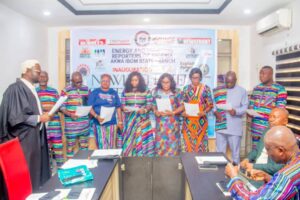
The Energy and Maritime Reporters of Nigeria (EMR), Akwa Ibom State Chapter, has urged Governor Umo Eno to establish a Ministry of Blue Economy, arguing that the state possesses enough maritime assets to become one of Nigeria’s leading blue economy hubs.
The call highlights growing concerns over the state’s inability to fully harness opportunities within its maritime domain, even as neighbouring states continue to benefit from activities linked to shipping, offshore operations, fisheries and marine services.
Akwa Ibom is estimated to have about 28 kilometres of coastline, more than 100 offshore platforms and rigs, 22 underdeveloped jetties and terminals, and thousands of vessels operating within its maritime environment. The state is also endowed with fisheries resources, aquatic organisms, sea salt deposits and kaolin minerals.
Yet, according to EMR, much of the economic value generated from these resources is not retained within the state.
The organisation said revenue streams from anchorage services, chandelling operations, stevedoring, local content participation and community assisted project valuations are largely being captured elsewhere, depriving Akwa Ibom of significant economic benefits.
Industry observers say the situation reflects a broader challenge facing many coastal states in Nigeria, where maritime resources remain underutilised despite their capacity to support economic diversification beyond crude oil.
EMR believes a dedicated ministry would provide a coordinated platform for policy development, investment promotion, regulation and sustainable management of maritime resources.
The proposed ministry, the organisation said, would also help establish a comprehensive database of vessels, offshore platforms, maritime service providers, seafarers and international oil companies operating within the state’s waters, strengthening oversight and improving revenue collection.
The group’s position comes at a time when Nigeria is increasingly looking towards the blue economy as a critical component of future economic growth.
The Federal Government established the Federal Ministry of Marine and Blue Economy to drive investment and policy reforms within the sector. Several states have also taken steps to institutionalise blue economy governance through dedicated ministries or specialised agencies.
EMR argued that Akwa Ibom should not be left behind, particularly given the strategic importance of the Liberty Oil and Gas Free Zone and Marine Solutions Hub, a development spanning more than 50,000 hectares across several local government areas including Ikot Abasi, Eastern Obolo, Mkpat Enin, Oruk Anam, Onna, Ibeno, Oron, Mbo, Okobo, Esit Eket and Eket.
According to the organisation, maritime activities within the state have the potential to generate more than 40,000 direct and indirect jobs across fisheries, aquaculture, marine logistics, maritime transportation, tourism, ship leasing, environmental services and other support sectors.
The group maintained that creating a Ministry of Blue Economy would not only increase internally generated revenue but also attract investments, strengthen local content participation and support the implementation of the state’s development agenda.
For a state whose economy has long depended on oil revenues, the debate over the blue economy raises broader questions about economic diversification and whether Akwa Ibom is doing enough to leverage its natural maritime advantages.
As competition for maritime investments intensifies across Nigeria’s coastal states, stakeholders argue that the real challenge is no longer the availability of resources, but the political will to create institutions capable of transforming those resources into sustainable economic opportunities.