

By Julius Nsikak
The Akwa Ibom State House of Assembly Committee on Local Government and Chieftaincy Affairs has commenced its statewide oversight exercise on the 31 local government councils, with the opening day producing a striking moment in Ikot Abasi Local Government Area where lawmakers were left visibly impressed by a massive 1.7 kilometre road project funded entirely by the council.
Although Ikot Abasi was the committee’s final stop after visits to Mkpat Enin and Eastern Obolo, it became the defining highlight of the day’s exercise, reinforcing what the lawmakers described as a practical demonstration of grassroots development under local government financial autonomy.
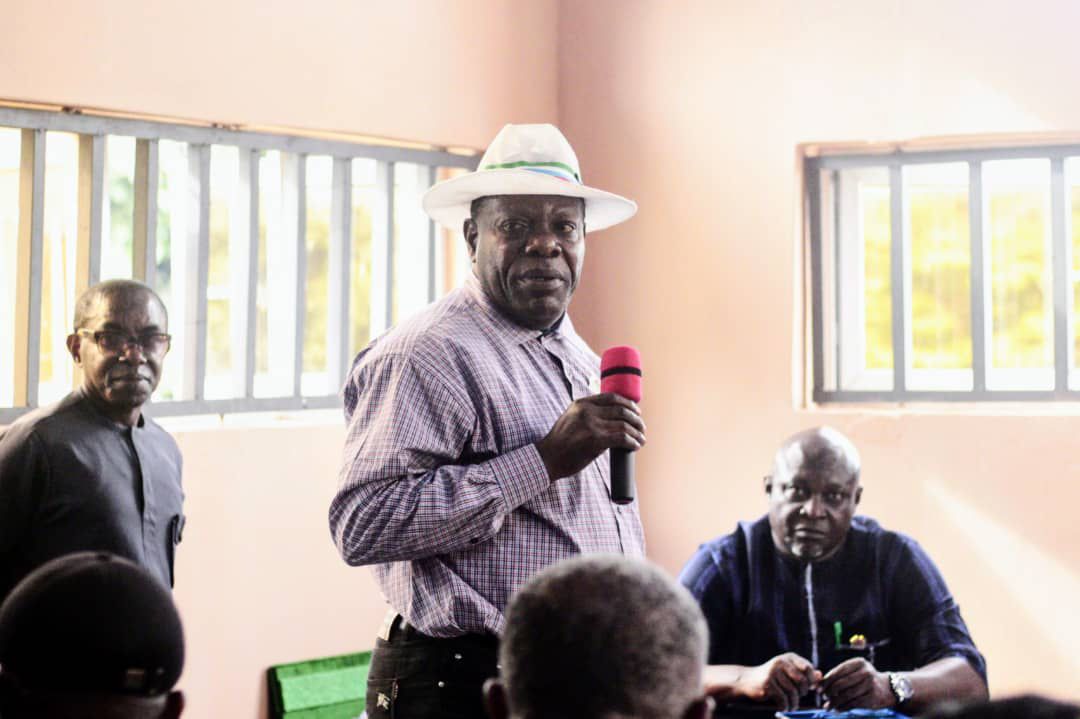
Led by the Committee Chairman and member representing Etim Ekpo/Ika State Constituency, Rt. Hon. Mfon Idung, the legislators explained that the tour was never intended as a witch hunt but as part of the Assembly’s constitutional responsibility to assess projects, evaluate the utilisation of public funds and hold public office holders accountable.
At Ikot Abasi, however, the oversight exercise took on a different complexion as the committee encountered the impressive 1.7 kilometre road project, complete with dual drainage and already about 85 per cent completed.
The scale of the project momentarily left members of the committee in disbelief. Even the committee chairman initially questioned whether such an ambitious project had indeed been funded solely by the local government council. Standing before the infrastructure, however, the project spoke for itself.
Commending the development, Rt. Hon. Idung attributed the visible transformation to Governor Umo Eno’s decision to allow local government allocations to reach the councils without interference.
According to him, financial autonomy has begun to yield tangible results across the state. He also appreciated President Bola Tinubu for reforms that have strengthened funding to local government councils.
He noted that the oversight exercise became necessary in line with the directive of the Speaker of the House, adding that beyond inspecting projects, the committee would also review records, verify expenditure and ensure that public office holders remain accountable for the management of public resources.
The committee chairman further urged council chairmen to settle outstanding entitlements owed to councillors, supervisors and principal officers, warning that unpaid liabilities often become burdens for succeeding administrations.
He disclosed that the committee’s findings would be compiled into a comprehensive report for presentation before the House during plenary and subsequently forwarded to Governor Umo Eno.
Beyond the signature road project, the Chairman of Ikot Abasi Local Government Council, Hon. Ime Williamson Essien, presented an impressive portfolio of projects undertaken by his administration. They include the empowerment of 41 beneficiaries with grants of N500,000 each, amounting to N20.5 million, renovation of a primary healthcare centre, installation of solar powered water facilities, extensive road grading, electrification projects across communities, payment of allowances to gazetted village and clan heads, renovation of the council hall, free prostate cancer screening and treatment campaign, educational support initiatives and the procurement of official vehicles for party executives, among other ongoing projects.
Earlier in the day, the committee had begun its oversight exercise in Mkpat Enin Local Government Area, where the council chairman, Hon. Emmanuel Inyang, described his administration as the “Emancipation Era”, a philosophy centred on transforming lives rather than merely constructing buildings.
According to him, the administration commenced with the construction and furnishing of what he described as one of the finest traditional rulers’ council complexes in Akwa Ibom State before extending interventions to youth empowerment, healthcare, education, rural electrification and infrastructure.
He disclosed that electricity had been restored to several communities after years without power through the installation and rehabilitation of transformers, while educational grants had been awarded to undergraduate and postgraduate students. Compassionate homes are also being built for vulnerable families, alongside the construction of an ultra modern motor park, renovation of the council secretariat and sustained healthcare programmes.
Inyang further revealed that nearly 70 kilometres of roads have been graded across the local government, stressing that his administration remains committed to touching lives rather than merely erecting structures.
“Development is not complete until human lives are transformed,” he said.
From Mkpat Enin, the lawmakers proceeded to Eastern Obolo, where the council chairman, Rt. Hon. Samuel Nteogwuijah, described the Assembly committee’s visit as an opportunity to showcase the progress recorded by his administration.
He highlighted several completed and ongoing projects, including compassionate homes for vulnerable residents, public sanitation facilities, solar powered water schemes, the ongoing reconnection of the local government to the national electricity grid and the completion of the council’s permanent secretariat, a project abandoned for more than 25 years.
The administration has also supported fishermen with outboard engines, empowered women and youths through grants, awarded bursaries and scholarships to students, strengthened healthcare delivery, embarked on road grading, promoted sports development, intervened in community disputes, resolved youth leadership crises and recruited 60 ad hoc workers to improve service delivery in schools, health centres and council departments.
As the first day of the oversight exercise drew to a close, one message stood out clearly. The committee’s assignment was not merely to listen to presentations but to verify claims through physical inspection.
Judging by the projects encountered across the three local government areas, the exercise has already begun to paint a picture of how financial autonomy is gradually reshaping grassroots governance in Akwa Ibom State. With 28 more councils still awaiting inspection, the coming days are expected to provide a broader assessment of development across the state.