


By Julius Nsikak
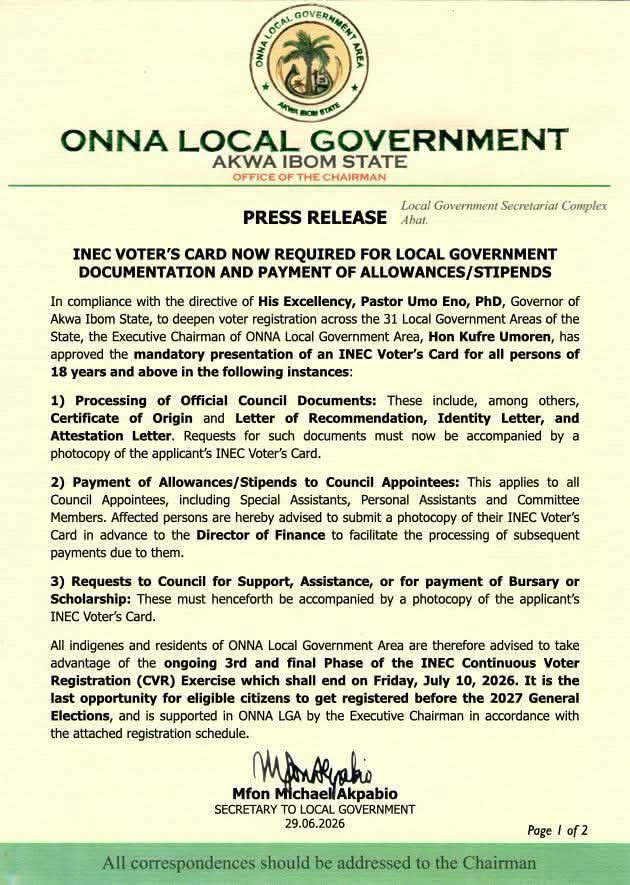
There is a dangerous habit creeping into public administration in Nigeria. It begins as an administrative directive, is packaged as a civic responsibility and quietly transforms a constitutional right into a privilege. The latest example is the decision by Onna Local Government Area to demand the presentation of an INEC Permanent Voter Card before citizens can obtain official council documents, receive allowances, or access bursaries and other forms of support.
This should worry every Nigerian, regardless of political affiliation.
The first question is simple. Since when did possession of a Permanent Voter Card become the legal test for citizenship? Nigeria already has recognised means of identification. We have birth certificates, National Identification Numbers (NIN), international passports, driver’s licences and numerous other lawful documents. None of Nigeria’s laws elevates the PVC above every other form of identification for access to government services.
The Constitution of the Federal Republic of Nigeria (CFRN) 1999 as amended guarantees equality before the law and protects citizens against discrimination. Nowhere does it state that a Nigerian who has not registered to vote forfeits the right to obtain a certificate of origin, an identification letter or government assistance. Voting is a civic responsibility. It is not a condition for enjoying constitutional rights.
The Electoral Act was enacted to regulate elections, voter registration and electoral processes. It was never designed to become a gatekeeper for scholarships, stipends or local government documentation. INEC issues voter cards for one purpose, participation in elections. Converting that document into a compulsory requirement for unrelated government services stretches both logic and legality beyond reasonable limits.
Supporters of the directive may say that it is intended to encourage voter registration ahead of the 2027 general elections. Civic participation is indeed desirable. Every democracy benefits when more citizens vote. However, persuasion and public enlightenment are entirely different from coercion. Government should educate citizens about the importance of voting, not compel them by threatening to deny services that are funded with taxpayers’ money.
What happens to the eligible citizen who has applied for a PVC but has not yet received it because of administrative delays? What becomes of the elderly resident who cannot easily travel to a registration centre? What about persons living with disabilities who continue to face barriers in the electoral registration process? Should they all be denied certificates, scholarships and welfare because bureaucracy has failed them?
The implications extend beyond elections. If local governments can demand PVCs today, what prevents another public institution from insisting on party membership tomorrow? What stops another agency from attaching political conditions to healthcare, education or employment? Democracies rarely lose freedoms overnight. They lose them gradually through administrative decisions that go unchallenged.
Local governments exist to serve residents, not to create additional barriers between citizens and public services. Certificates of origin, recommendation letters and welfare programmes are public functions financed by public resources. They should be available to every eligible citizen under transparent and lawful criteria.
This directive also raises troubling questions about abuse of administrative power. Even if a governor encourages increased voter registration, that cannot override the Constitution or create new legal qualifications where none exist. Executive directives cannot substitute for legislation. Administrative convenience cannot replace the rule of law.
Nigeria has fought too hard to build democratic institutions to allow electoral documents to become instruments of exclusion. The irony is painful. A document created to strengthen democracy is now being used to restrict access to government services.
If public officials genuinely wish to increase voter registration, they should invest in civic education, expand registration centres, improve accessibility, eliminate delays and build public confidence in the electoral system. Citizens should register because they believe their votes matter, not because they fear losing access to public services.
The real question is not whether Nigerians should obtain a PVC. They should.
The real question is whether government has the legal and moral authority to punish those who do not.
Until someone points to the exact provision of the Constitution or the Electoral Act that authorises a local government to make a PVC a mandatory condition for accessing unrelated public services, this directive appears less like democratic governance and more like administrative overreach dressed up as civic responsibility.
A democracy governed by law should persuade citizens to vote.
It should never compel them by holding their rights hostage.