

By Julius Nsikak
For most of human history, women did not give birth lying on their backs.
They gave birth while standing.
They gave birth while squatting.
They gave birth while kneeling.
They gave birth while sitting on specially designed birthing stools.
These positions were common across continents and cultures for thousands of years.
The image of a woman lying on a hospital bed during labour is therefore not as ancient as many people assume.
In fact, it is a relatively modern development in the long story of childbirth.
For centuries, childbirth was viewed as an active process.
Women moved their bodies freely during labour.
They changed positions according to comfort and necessity.
They relied on gravity to help bring their babies into the world.
Traditional birth attendants and midwives worked with these natural movements.
The widespread practice of lying down during childbirth emerged much later.
Its rise was linked to the growth of modern medicine and hospital-based care.
Today, researchers continue to examine whether lying down is truly the best position for childbirth.
The answer, according to growing evidence, may be more complex than many people realise.
Childbirth in the Earliest Human Communities
—————————————————–
Long before hospitals existed, women gave birth in natural environments.
They delivered babies in homes.
They delivered babies in huts.
They delivered babies in caves.
They delivered babies surrounded by female relatives and experienced birth attendants.
Archaeological evidence suggests that upright childbirth positions were common in ancient societies.
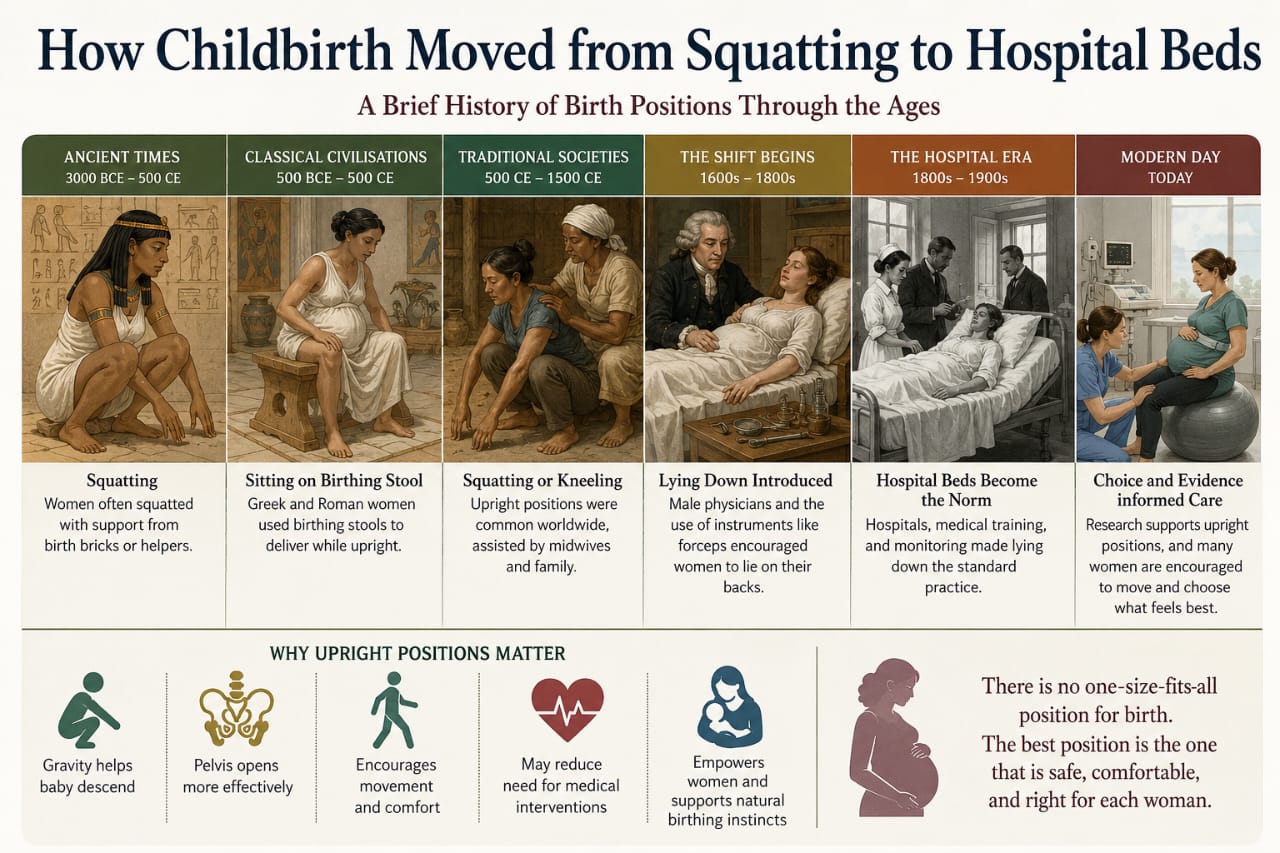
Ancient Egyptian carvings depict women squatting during labour.
These images date back more than three thousand years.
Egyptian women sometimes used specially constructed birth bricks for support.
The bricks helped them maintain a stable squatting position.
Similar practices existed in Mesopotamia.
Historical records show that women often remained upright during labour.
Ancient Greek women frequently used birthing stools.
These stools allowed them to sit while gravity assisted delivery.
Roman women also used similar methods.
The birthing stool became one of the most recognised childbirth tools of the ancient world.
Across Africa, upright childbirth positions were widely practised.
Women often squatted or knelt during labour.
Traditional midwives assisted them throughout the process.
Many communities viewed childbirth as a natural event rather than a medical condition.
Among Indigenous peoples in the Americas, women commonly gave birth while standing or squatting.
Family members often provided physical and emotional support.
In Asia, similar traditions existed.
Historical records from China, India and Japan show that upright positions were common during labour.
For much of human history, lying flat during childbirth was unusual.
Most societies understood, either consciously or instinctively, that gravity could help the birthing process.
Why Upright Birth Positions Were Favoured
————————————————–
The preference for upright positions was not accidental.
Women often found these positions more comfortable.
Gravity helped the baby move downward through the birth canal.
The mother’s pelvis could open more effectively.
Movement helped women respond naturally to contractions.
Changing positions often reduced discomfort.
Upright postures also reduced pressure on certain blood vessels.
This could improve circulation for both mother and baby.
Traditional midwives observed these benefits over generations.
Their knowledge was passed from one generation to another.
Although they lacked modern scientific language, they possessed practical experience gained through countless births.
This experience shaped childbirth traditions around the world.
The Beginning of Change
——————————-
The transition towards lying down began gradually.
It emerged primarily in Europe.
One frequently cited explanation involves King Louis XIV of France.
Historical accounts suggest that the French monarch enjoyed observing childbirth among members of the royal court.
Some historians argue that he preferred women to recline because it provided a clearer view.
While historians continue to debate the accuracy of this story, it remains one of the most famous explanations for the change.
However, the rise of male physicians likely played a much larger role.
For centuries, childbirth had been dominated by female midwives.
Women cared for women during labour.
This tradition began to change during the seventeenth century.
Male doctors increasingly entered the field of obstetrics.
They brought new instruments and new methods.
One of the most significant innovations was the forceps.
Forceps allowed doctors to assist difficult deliveries.
The instrument worked most effectively when the mother was lying down.
Doctors therefore began encouraging women to adopt this position.
Medical convenience gradually became a major factor in childbirth practices.
The Hospital Revolution
—————————–
The nineteenth century transformed healthcare.
Hospitals became increasingly important.
Medical education expanded.
Scientific discoveries accelerated.
Doctors gained greater authority over childbirth.
As childbirth moved from homes to hospitals, birth practices changed accordingly.
Hospital beds were designed for patients to lie down.
Medical staff found it easier to monitor labouring women who remained in bed.
Examinations could be performed more conveniently.
Interventions could be carried out more quickly.
The lying-down position became standard procedure.
By the twentieth century, it had become deeply embedded in medical practice.
Millions of women gave birth in hospitals.
Many accepted the position as normal.
Few realised that it represented a major departure from centuries of childbirth tradition.
The Benefits of Modern Obstetrics
—————————————–
It is important to acknowledge the achievements of modern medicine.
Maternal mortality has declined dramatically in many parts of the world.
Infant survival rates have improved significantly.
Antibiotics have saved countless lives.
Blood transfusions have prevented deaths from severe bleeding.
Caesarean sections have provided life-saving interventions in emergencies.
Modern obstetrics has transformed childbirth safety.
Without these advances, many mothers and babies would not survive complications.
The debate about birth positions should therefore not be interpreted as a rejection of modern medicine.
Rather, it is a discussion about how medical care can best support women during labour.
What Modern Research Reveals
————————————
Researchers have increasingly examined the effects of different birth positions.
Many studies suggest that upright positions can provide advantages during labour.
Labour may progress more quickly.
Contractions may become more effective.
The baby may descend more easily.
The need for assisted delivery may be reduced.
Women often report feeling more in control.
Many women also describe greater comfort when they are allowed to move freely.
Squatting can increase the diameter of the pelvic outlet.
Kneeling may reduce pressure on the lower back.
Standing can help gravity assist the baby’s movement.
Walking during labour may encourage progress.
These findings have led many maternity experts to reconsider traditional assumptions about childbirth positions.
Are There Benefits to Lying Down?
—————————————
Despite criticism of the practice, lying down is not always harmful.
In some circumstances, it may be necessary.
Certain medical complications require close monitoring.
Emergency interventions may need to be performed rapidly.
Women who receive epidural anaesthesia may have limited mobility.
Some mothers become physically exhausted during prolonged labour.
In such situations, lying down may offer practical benefits.
The key issue is not whether lying down is always wrong.
The key issue is whether women should be required to remain in that position when alternatives may be available.
Is Lying Flat the Best Position?
———————————–
Many experts argue that lying completely flat is often less favourable than upright alternatives.
Gravity cannot assist as effectively.
The weight of the uterus may compress major blood vessels.
Blood flow may be reduced.
Some women experience increased discomfort in this position.
Research suggests that freedom of movement may improve the overall labour experience.
As a result, many hospitals now encourage women to change positions during labour.
Women may sit.
They may kneel.
They may squat.
They may use birthing balls.
They may lean forward.
They may adopt whichever position feels most natural and comfortable.
The Importance of Choice
——————————
Perhaps the most important lesson from the history of childbirth is the importance of choice.
No single position is perfect for every woman.
Every labour is different.
Every pregnancy is different.
Every mother is different.
Healthcare providers increasingly recognise the value of personalised care.
Women should be informed about available options.
They should understand the benefits and limitations of different positions.
They should be supported in making decisions that suit their individual circumstances.
Medical safety must always remain the priority.
However, safety and autonomy do not have to be opposing goals.
The best outcomes often emerge when scientific evidence and maternal preference work together.
In CONCLUSION, the history of childbirth is also a history of changing ideas about women’s bodies.
For thousands of years, women gave birth while upright.
Squatting, standing, kneeling and sitting were the norm across much of the world.
The widespread adoption of the lying-down position occurred relatively recently.
It was influenced by the rise of physicians, medical instruments and hospital-based care.
Modern research suggests that upright positions may offer significant advantages for many women.
At the same time, lying down remains appropriate in certain medical situations.
The evidence increasingly points towards flexibility rather than rigid rules.
Women should not be forced into a single position simply because it has become customary.
Instead, they should be empowered with knowledge, supported by skilled healthcare professionals and allowed to labour in ways that are both safe and comfortable.
In many respects, the future of childbirth may involve rediscovering some of the wisdom that accompanied mothers throughout the earliest chapters of human history.