

By Julius Nsikak
When Mrs. Nehemiah Okon, a deaf and non-verbal expectant mother, enrolled in the Akwa Ibom State Health Insurance Scheme through one of the agency’s accredited antenatal providers, she began a journey that would spare her family catastrophic medical bills.
On her delivery date, she underwent a caesarean section and left the facility without paying a naira. Under the ARISECare scheme, antenatal care, laboratory tests and delivery were covered. In many private and public hospitals across the state, such procedures can cost between ₦250,000 and ₦450,000, placing them beyond the reach of low income families.
The intervention prevented complications linked to eclampsia, a leading cause of maternal mortality. In a video shared on Facebook by her husband on 21st December 2025, Mrs Okon expressed gratitude through sign supported communication.
“Thank God for a successful surgery. I am safe and healthy. My baby is healthy. I could not have afforded the cost of the surgery, but through the state health insurance scheme, I was able to access care. As a deaf and non-verbal person, this opportunity has given me a chance to live again,” she said. “May God continue to bless the governor and grant success to his administration”.
Her experience reflects the growing role of the Akwa Ibom State Health Insurance Scheme, branded ARISECare, in expanding healthcare access for vulnerable groups, particularly Persons with Disabilities (PWDs).
Legal Foundation and Benefits
The Akwa Ibom State Health Insurance Agency is a statutory body established by the State House of Assembly to coordinate and implement the health insurance programme. The legislation provides for compulsory health insurance for residents, with the aim of achieving universal health coverage and reducing out of pocket medical expenses.
The scheme was formally launched on 20th September 2024 in Uyo by Governor Umo Bassey Eno as part of his administration’s ARISE Agenda. At the launch, the governor approved ₦180 million to enrol 9,150 junior civil servants on Grade Levels 1 to 6.
Residents may enrol as individuals, families or organised groups. The annual premium is ₦18,000 for individuals and ₦96,000 for a family of six, while group enrolment attracts a discounted rate of ₦17,000 per person. The benefit package covers primary healthcare, maternal and child health services, emergency care, hospital treatment and prescribed medicines through accredited public and private facilities.
Akwa Ibom State’s official population is estimated at about 7.45 million people according to state government data, reflecting rapid demographic growth and rising demand for health services.
Disability Focused Enrolment
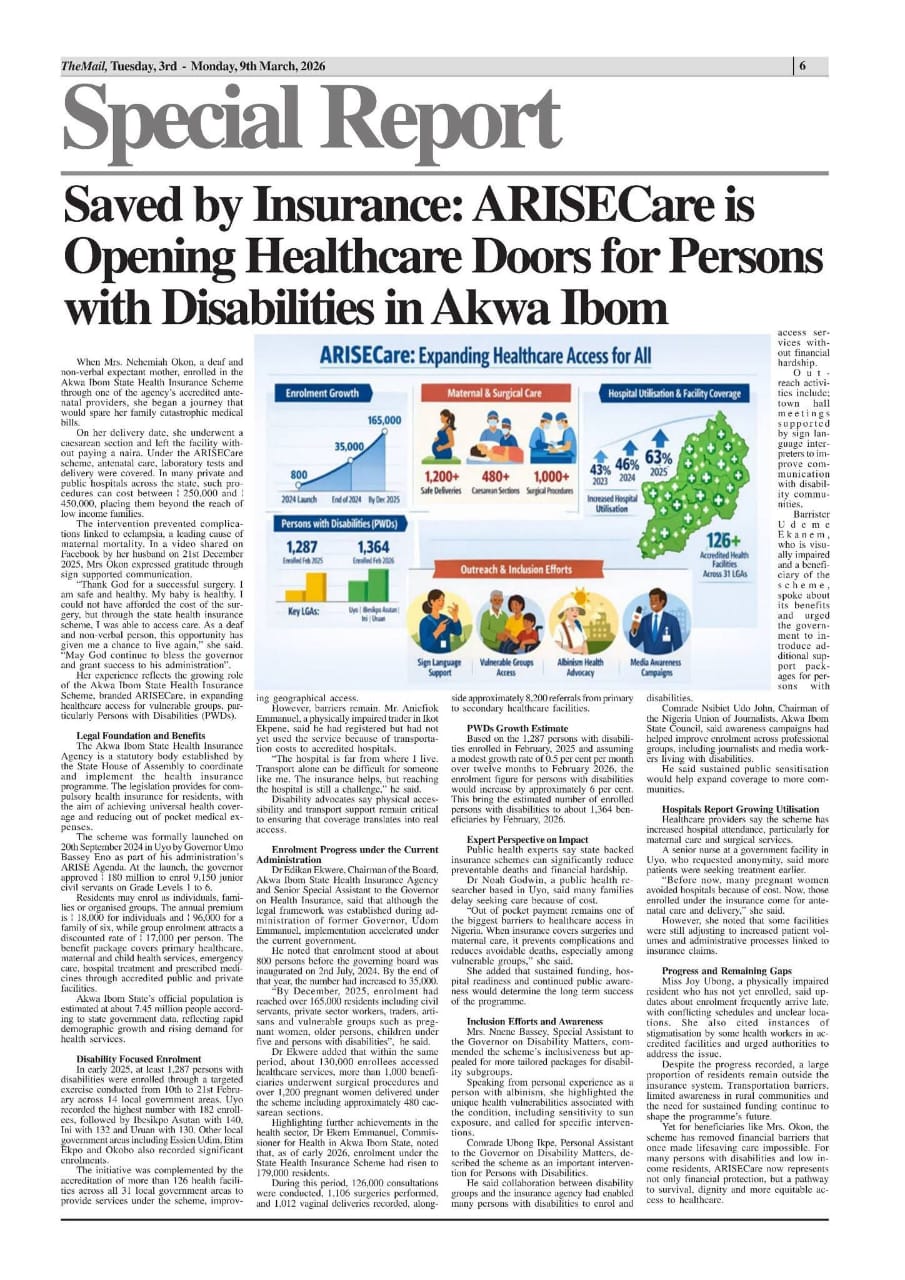
In early 2025, at least 1,287 persons with disabilities were enrolled through a targeted exercise conducted from 10th to 21st February across 14 local government areas. Uyo recorded the highest number with 182 enrollees, followed by Ibesikpo Asutan with 140, Ini with 132 and Uruan with 130. Other local government areas including Essien Udim, Etim Ekpo and Okobo also recorded significant enrolments.
The initiative was complemented by the accreditation of more than 126 health facilities across all 31 local government areas to provide services under the scheme, improving geographical access.
However, barriers remain. Mr. Aniefiok Emmanuel, a physically impaired trader in Ikot Ekpene, said he had registered but had not yet used the service because of transportation costs to accredited hospitals.
“The hospital is far from where I live. Transport alone can be difficult for someone like me. The insurance helps, but reaching the hospital is still a challenge,” he said.
Disability advocates say physical accessibility and transport support remain critical to ensuring that coverage translates into real access.
Enrolment Progress under the Current Administration
Dr Edikan Ekwere, Chairman of the Board, Akwa Ibom State Health Insurance Agency and Senior Special Assistant to the Governor on Health Insurance, said that although the legal framework was established during administration of former Governor, Udom Emmanuel, implementation accelerated under the current government.
He noted that enrolment stood at about 800 persons before the governing board was inaugurated on 2nd July, 2024. By the end of that year, the number had increased to 35,000.
“By December, 2025, enrolment had reached over 165,000 residents including civil servants, private sector workers, traders, artisans and vulnerable groups such as pregnant women, older persons, children under five and persons with disabilities”, he said.
Dr Ekwere added that within the same period, about 130,000 enrollees accessed healthcare services, more than 1,000 beneficiaries underwent surgical procedures and over 1,200 pregnant women delivered under the scheme including approximately 480 caesarean sections.
Highlighting further achievements in the health sector, Dr Ekem Emmanuel, Commissioner for Health in Akwa Ibom State, noted that, as of early 2026, enrolment under the State Health Insurance Scheme had risen to 179,000 residents.
During this period, 126,000 consultations were conducted, 1,106 surgeries performed, and 1,012 vaginal deliveries recorded, alongside approximately 8,200 referrals from primary to secondary healthcare facilities.
PWDs Growth Estimate
Based on the 1,287 persons with disabilities enrolled in February, 2025 and assuming a modest growth rate of 0.5 per cent per month over twelve months to February 2026, the enrolment figure for persons with disabilities would increase by approximately 6 per cent. This bring the estimated number of enrolled persons with disabilities to about 1,364 beneficiaries by February, 2026.
Expert Perspective on Impact
Public health experts say state backed insurance schemes can significantly reduce preventable deaths and financial hardship.
Dr Noah Godwin, a public health researcher based in Uyo, said many families delay seeking care because of cost.
“Out of pocket payment remains one of the biggest barriers to healthcare access in Nigeria. When insurance covers surgeries and maternal care, it prevents complications and reduces avoidable deaths, especially among vulnerable groups,” she said.
She added that sustained funding, hospital readiness and continued public awareness would determine the long term success of the programme.
Inclusion Efforts and Awareness
Mrs. Nnene Bassey, Special Assistant to the Governor on Disability Matters, commended the scheme’s inclusiveness but appealed for more tailored packages for disability subgroups.
Speaking from personal experience as a person with albinism, she highlighted the unique health vulnerabilities associated with the condition, including sensitivity to sun exposure, and called for specific interventions.
Comrade Ubong Ikpe, Personal Assistant to the Governor on Disability Matters, described the scheme as an important intervention for Persons with Disabilities.
He said collaboration between disability groups and the insurance agency had enabled many persons with disabilities to enrol and access services without financial hardship.
Outreach activities include; town hall meetings supported by sign language interpreters to improve communication with disability communities.
Barrister Udeme Ekanem, who is visually impaired and a beneficiary of the scheme, spoke about its benefits and urged the government to introduce additional support packages for persons with disabilities.
Comrade Nsibiet John, Chairman of the Nigeria Union of Journalists, Akwa Ibom State Council, said awareness campaigns had helped improve enrolment across professional groups, including journalists and media workers living with disabilities.
He said sustained public sensitisation would help expand coverage to more communities.
Hospitals Report Growing Utilisation
Healthcare providers say the scheme has increased hospital attendance, particularly for maternal care and surgical services.
A senior nurse at a government facility in Uyo, who requested anonymity, said more patients were seeking treatment earlier.
“Before now, many pregnant women avoided hospitals because of cost. Now, those enrolled under the insurance come for antenatal care and delivery,” she said.
However, she noted that some facilities were still adjusting to increased patient volumes and administrative processes linked to insurance claims.
Progress and Remaining Gaps
Miss Joy Ubong, a physically impaired resident who has not yet enrolled, said updates about enrolment frequently arrive late, with conflicting schedules and unclear locations. She also cited instances of stigmatisation by some health workers in accredited facilities and urged authorities to address the issue.
Despite the progress recorded, a large proportion of residents remain outside the insurance system. Transportation barriers, limited awareness in rural communities and the need for sustained funding continue to shape the programme’s future.
Yet for beneficiaries like Mrs. Okon, the scheme has removed financial barriers that once made lifesaving care impossible. For many persons with disabilities and low income residents, ARISECare now represents not only financial protection, but a pathway to survival, dignity and more equitable access to healthcare.