

…as State Launches Mass Distribution of Insecticide-Treated Nets to Protect Every Household
By Julius Nsikak, Uyo
The Akwa Ibom State Government, through its Ministry of Health in partnership with the United States Government and Against Malaria Foundation (AMF), has announced a massive campaign to distribute not fewer than 3.9 million Insecticide-Treated Nets (ITNs) to households across the state.
The exercise, scheduled for 20th to 26th June 2026, will involve over 16,500 personnel working at state and local government levels to ensure every family is reached.
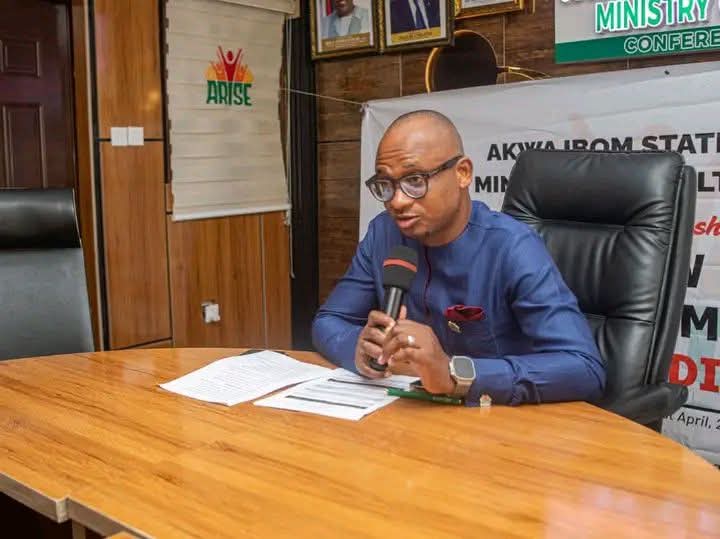
Hon. (Dr.) Ekem Emmanuel, Commissioner for Health, disclosed the initiative during a media parley on Monday, at the Ministry of Health Conference Hall, Idongesit Nkanga Secretariat, Uyo, where he emphasised that malaria prevalence in Akwa Ibom has dropped significantly, from 30.1 per cent in 2021 to 15.5 per cent in 2025, under Governor Umo Eno’s ARISE Agenda which prioritises healthcare. “Our target is to drive malaria prevalence below five per cent, moving towards pre-elimination,” he declared.
“Malaria is a disease transmitted to people through the bites of infected female Anopheles mosquitoes and can be life-threatening to children and pregnant women. Nigeria accounts for over 68 million malaria cases annually (World Malaria Report, 2025), and an estimated 30 per cent of child and 11 per cent of maternal deaths each year are due to malaria. Malaria remains the most common cause of absenteeism from schools, offices, farms, markets, resulting in lower productivity. It exerts a huge social and economic burden on our communities and country, billions of naira are lost to malaria annually in the form of treatment cost, prevention, and loss of man hours,” Emmanuel explained.
He stressed that sleeping inside insecticide-treated nets is one of the most effective ways to prevent malaria, serving as both a physical and chemical barrier against mosquitoes. “Studies show that the use of ITNs reduced malaria incidence by 50 per cent in sub-Saharan Africa, a region that accounts for more than 90 per cent of global cases,” he added.
Household Mobilisation and Distribution Process
Before distribution begins, households will be registered between 1st and 7th June 2026. Uniformed personnel bearing malaria campaign logos will visit homes to issue token slips. Each slip entitles a household to one free net. A female representative of each household will then collect the nets at designated distribution points during the campaign week.
Dr. Emmanuel advised, “Once collected, the new nets should be spread out to air under a shade for 24 hours before hanging it in the sleeping area. Every member of the family should sleep inside with the nets well-tucked over the sleeping area every night all year round to prevent malaria.”
He commended Governor Eno for his commitment to malaria elimination and urged journalists to spread awareness. “Akwa Ibom people should come out and collect and as well make good use of these insecticide-treated nets. When you get your nets, ensure to air it properly, at least 24 hours before use, hang it well and sleep inside the net regularly,” he stressed.
Campaign Funding and Technology
Mrs. Patience Ochibe, Campaign Manager for the Global Health Supply Chain Programme, Procurement and Supply Management (GHSC-PSM), provided further details. She noted that Akwa Ibom last held an ITN distribution in 2022 and is now due for another. “For the 2026 campaign, AMF has procured 3,982,100 nets at a cost of over $8 million. The state government, in partnership with the US Government, will fund the implementation.”
She added that Information and Communication Technology for Development (ICT4D) will be deployed to enhance efficiency, while expired nets will be recovered and campaign waste managed sustainably across local government areas.
Addressing Concerns about Side Effects and Drug Resistance
Responding to questions about possible side effects of ITNs, ministry officials reassured residents, “It is known that if it is hung under a shade for 24 hours you have the normal expected residual quantity of the chemicals on the net. The dosage of exposure to a chemical increases the possible side effects, but if properly used, there will be little or no side effects. Even if there are, health facilities are equipped to manage them, with toll-free lines and ambulance services available.”
On recurrent malaria infections and fears of drug resistance, officials acknowledged that inappropriate self-medication has been a problem. They stressed the importance of testing before treatment, noting that fever has over 120 possible causes.
“The last publication I learnt showed that over 50 per cent of cases being treated for malaria were not really malaria cases, and that’s disturbing,” one senior officer explained.
They assured that Nigeria’s recommended antimalarial combination therapies remain highly effective. “The National Malaria Elimination Programme has been doing therapeutic efficacy studies every three years, and in Nigeria, currently all the best combination therapies are still 99.9 per cent effective. We are sure we have not reached that resistance rate.”
Media Support and Community Mobilisation
Comrade Nsibiet John, Chairman of the Nigeria Union of Journalists (NUJ), Akwa Ibom State Council, applauded the government and partners for their intervention. He pledged that journalists would ensure awareness reaches every corner of the state. “We will take this message to every household so that nets are not only collected but used correctly,” he affirmed.