

By Julius Nsikak
Inclusive education has long been preached in Nigeria, a lofty mantra often recited, but rarely practised. In reality, it has remained half-baked, bottled at the neck.
In Akwa Ibom, it is more of a rumour, a romanticised slogan, and a cosmetic display meant to mask systemic exclusion.
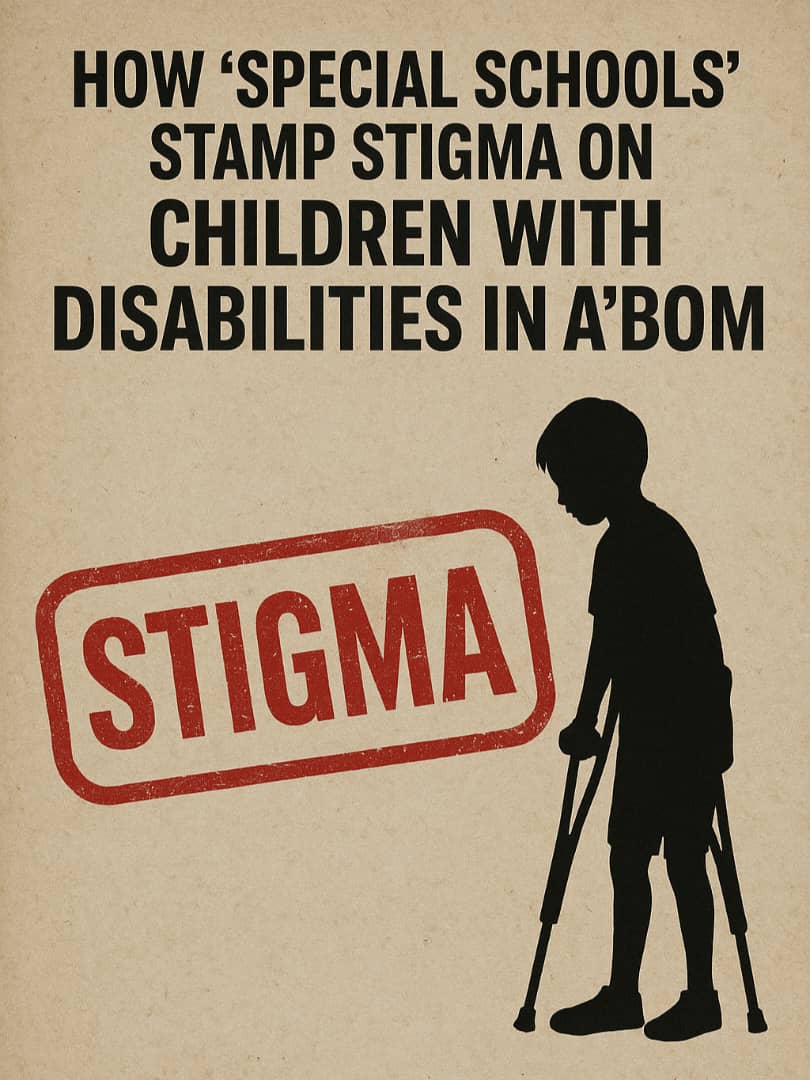
For what reasons should there be a so-called specialised school for persons with disabilities? Take, for instance, the institution boldly labelled “Special People’s School” along Afaha Road in Uyo. Is this not a subtle mockery, a well-clothed form of stigmatisation? A supposed sanctuary that, in fact, entrenches segregation with a faintly sympathetic crown. If so, it is nothing short of deceit, deaf stories told to the gods.
Let it be known clearly that there is no true inclusive education in Akwa Ibom if this continues. Unless the gospel of educational inclusivity for persons with disabilities is entrenched across all primary and secondary schools in the State, we cannot genuinely claim to be practising it. If it is possible to mandate compulsory teaching of indigenous languages such as Ibibio, and vocational subjects such as trading and marketing, why is it so difficult to mandate inclusive education?
Enough of pretence and side-lining. The Ministry of Education, Akwa Ibom State can no longer afford to sit on the fence as mere watchdogs or “sidon look.” It must demonstrate proactiveness by equipping teachers, both in government and private schools with specialised training to handle diverse learning needs, instead of restricting such training to “special schools.”
A child living with an impairment within a community should have the right to learn in the nearest neighbourhood school, not be compelled to journey from Ibiono to Uyo, or like travelling from France to Nigeria, simply to gain access to education. Inclusive education is not a favour. It is a right. Until Akwa Ibom embraces this truth, every inscription of “Special People’s School” will remain an official stamp of stigma, segregation, and exclusion.
According to Ms. Ubong Joy, a social inclusion advocate, inclusive education is not just about putting children with disabilities in the same school as others. It is about ensuring that they can truly learn, participate, and thrive in that environment. “Too often, people think building a ramp is enough. But a ramp alone does not make a school accessible, especially when many of the ramps we see are too steep or poorly designed.
We need to ask; are the classrooms and corridors wide enough for wheelchair users? Are the restrooms accessible? Are teachers trained to handle diverse learning needs? Most importantly, has the curriculum been adjusted to accommodate every child?
Inclusive infrastructure is only one part of the conversation. Real inclusivity in education demands curriculum reform, trained personnel, and, above all, proper adoption and implementation of inclusive education policies. Without implementation, adoption is nothing more than a paper promise”, she added.
Structurally, the current state of schools is appalling. The majority of private and public primary and secondary schools lack visible infrastructure that enables access for persons with disabilities. A wheelchair user, for instance, is often faced with steep staircases, narrow entrances, or classroom doors too tight to navigate. Few schools provide ramps, handrails, or lifts. There are no tactile walkways for the visually impaired, no audio-visual aids for hearing-impaired learners, and no provision of ergonomic furniture or adjustable desks that cater to physical needs. Even toilets in most schools remain inaccessible, perched on high platforms without grab bars or wide entrances.
To truly qualify as inclusive, a school must provide: Step-free access through ramps, wide doors, and corridors; accessible toilets and washrooms with supportive facilities for wheelchair users; braille textbooks, tactile learning aids, and screen-reading technology for visually impaired pupils.
Sign-language interpreters and captioned learning tools for the hearing impaired; specialised training for teachers to manage diverse abilities in one classroom; safe playgrounds and recreational spaces adapted for all children.
Only when these facilities and policies are mainstreamed will Akwa Ibom State move away from segregated “special” institutions to genuinely inclusive schools. Until then, “special schools” will continue to echo not compassion, but stigma.