
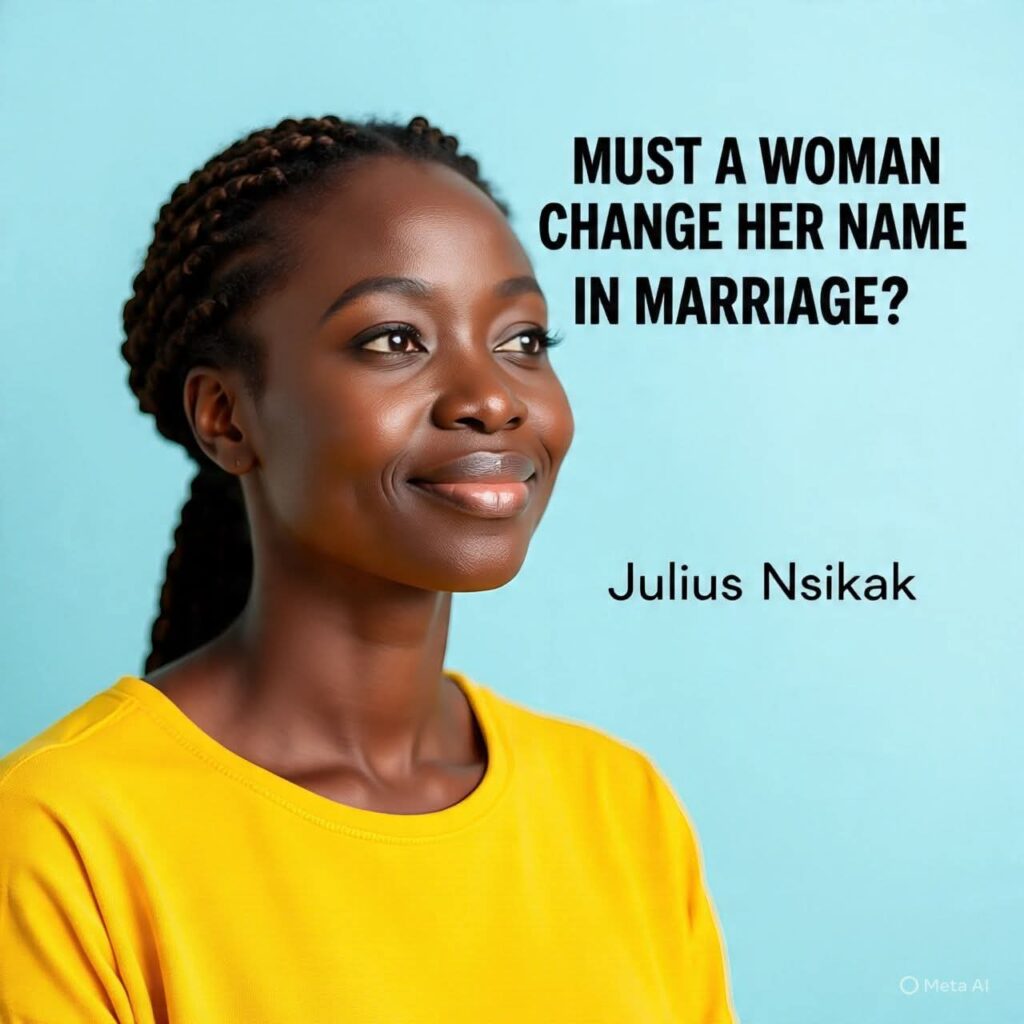
By Julius Nsikak
A wife is not automatically entitled nor compelled by law to abandon her father’s name and take on her husband’s. Yet, in many parts of Africa, particularly in Akwa Ibom State, Nigeria, it has become an unquestioned practice that once a woman marries, she must shed her identity like old clothing and wrap herself in her husband’s name.
But let us ask: where exactly is this prescribed? Which law demands it? None. It is a cultural habit dressed up as tradition, and worse, it reeks of subtle human trade by marriage.
Why should a woman, who has carried her father’s name proudly for decades, suddenly erase it simply because she met a man, fell in love, and exchanged vows! Is marriage meant to be a partnership of equals, or a silent transfer of ownership from father to husband?
The truth is uncomfortable: African men, conditioned by patriarchy, believe they own their wives. They see a married woman as someone who has no further claim to her father’s house, and no independent identity beyond her husband’s shadow. It is why many insist she must take his name, because in their mind, she has been “BOUGHT”.
This thinking is not only outdated; it is dangerous. It reduces women to property and strips them of lineage and heritage. Why can’t a married woman retain her father’s name while also carrying her husband’s, if she so chooses? Why must she be coerced into abandoning her identity?
Consider this: the children will naturally answer their father’s surname. That is already the norm in Africa. But must the mother too disappear into that same name, as though she never had roots, never had a family, never had an origin?
This practice has wider consequences. Many married women are deprived of recognition in their own lineage. Their children are made to belong entirely to the man’s side of the family, with no formal acknowledgment of the mother’s origin. In fact, if we carry this to its logical end, it raises a bold question: why can’t children belong equally to both local governments or states of origin? Why is identity monopolised by the man alone?
Some Christians argue that the Bible prescribes this practice, quoting Genesis 2:24: “Therefore shall a man leave his father and his mother, and shall cleave unto his wife: and they shall be one flesh.” But this verse has been widely misinterpreted. It speaks of unity in spirit, purpose, and relationship, not of a woman being forced to erase her name or surrender her identity.
Becoming “one” does not mean one person must vanish into the other; it means two individuals are joined in partnership. The scripture places the responsibility on the man to leave his family and cleave to his wife, not on the woman to abandon her lineage or heritage. Using the Bible to justify a patriarchal culture of name changing is therefore a distortion of its true intent.
Most importantly, the Nigerian Constitution itself does not compel any woman to change her surname after marriage. Section 42 of the 1999 Constitution (as amended) guarantees freedom from discrimination on the grounds of sex, and Section 37 guarantees the right to private and family life, which includes personal identity. In practice, many Nigerian women who choose to retain their maiden names face no legal barrier; in fact, court cases have affirmed that a woman has the right to be known by her chosen name, whether it is her father’s, her husband’s, or a combination of both.
Marriage is meant to be a union, not an erasure. Women should be free to decide whether or not to change their names, not forced by tradition, in-laws, or the weight of a patriarchal society.
It is time to question the so-called traditions that deny women their identity. Changing a surname should be a matter of choice, not compulsion. Until then, the practice remains nothing short of cultural colonisation of women.