
By Julius Nsikak
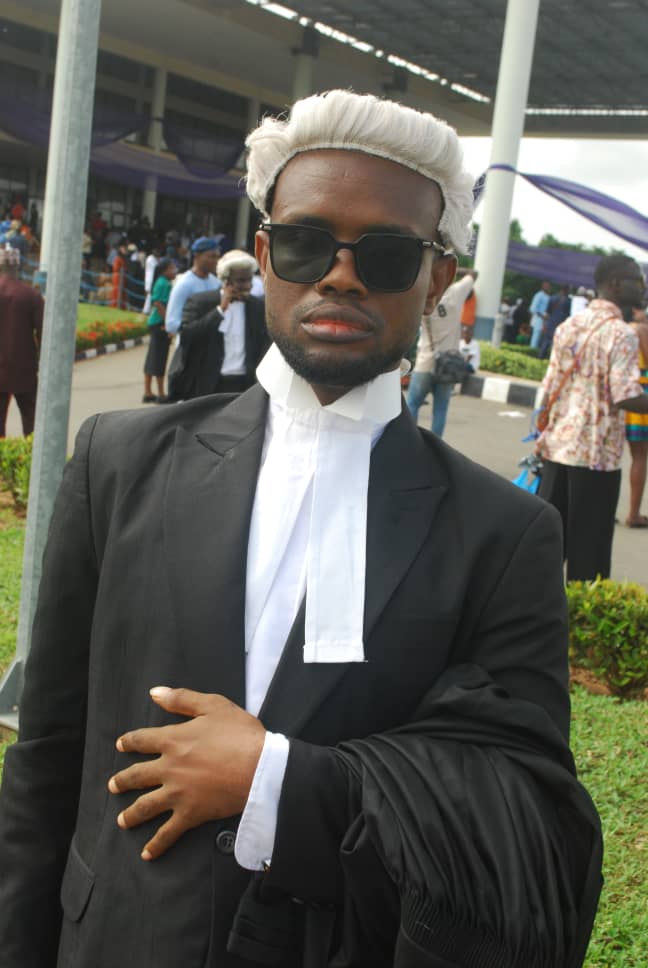
At 28, Barr. Udeme Emmanuel Ekanem was looking forward to the excitement of his graduation as a final-year law student at the University of Uyo. But for him, the journey to that point was a long climb against darkness, limitations, and systemic neglect.
Udeme was diagnosed with congenital glaucoma as an infant, less than a year old. His parents, fearful of losing their child’s vision completely, refused to allow corrective surgery. What began as a childhood illness ended in lifelong blindness, as he lost his sight entirely at the age of 10. For the past twenty-one years, Udeme has lived without the privilege of seeing the faces of his loved ones, the beauty of daylight, or the textbooks that his peers read so effortlessly.
“Every day is a struggle,” Udeme admitted in a quiet voice. “Sometimes I feel like I am living in a different world, one I can’t touch, see, or explain. But I believe my disability should not stop my dream.”
Raised in Ikono Local Government Area of Akwa Ibom State, Udeme was brought up by his mother, who bore the heavy responsibility of caring for him and his two younger siblings still in school. Yet, instead of giving in to despair, he chose education as his ladder out of poverty and the stigma surrounding disability.
CLIMBING THE ACADEMIC WALLS
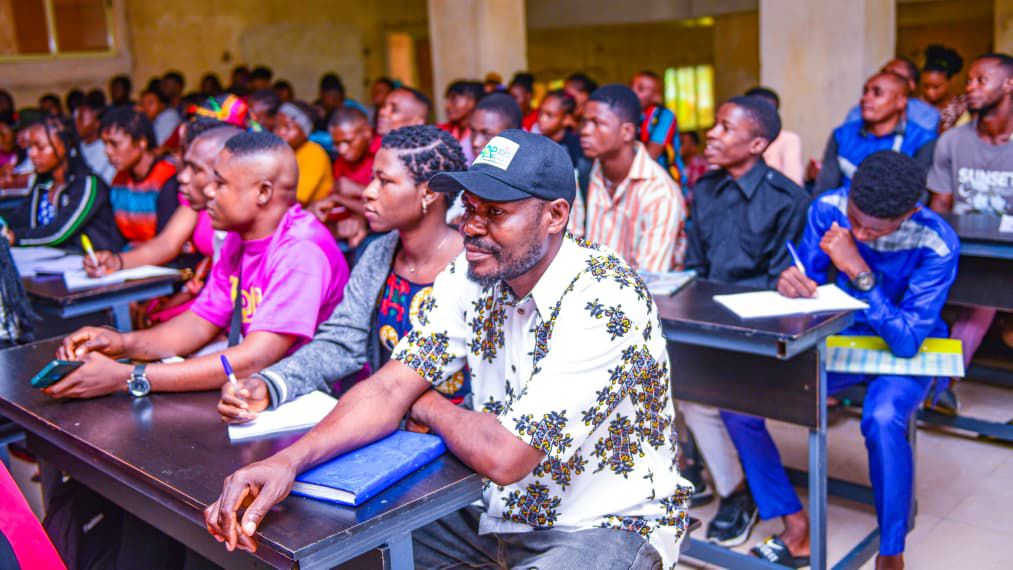
Studying law was far from easy. Udeme could not flip through hundreds of case law reports or statutory texts like his classmates. Instead, he relied on audio recordings, screen-reading software, and the goodwill of classmates who volunteered to read aloud for him. Often, when his peers were occupied with their own academic work, Udeme was left behind.
“The law programme is designed with the assumption that every student can read volumes of material,” he explained. “But for someone like me, each paragraph feels like climbing a mountain without a guide. I didn’t want pity. I just needed the system to understand that I learn differently.”
“I recall when I attended an Argument and Evidence course, and my lecturer harassed me badly, insisting that I stand until the lecture ended. It was only the intervention of the Head of Department that saved me. Another lecturer in the faculty, unaware of my situation, even attempted to break my phone because I was recording his lecture, something he absolutely prohibited.”
Udeme’s case was not isolated. Across Nigeria, students with disabilities struggle for equal access to education. Despite a population of over 35 million Nigerians living with disabilities as of 2023, nearly one in five citizens, very few are enrolled in higher institutions. JAMB records show that in 2019, only 182 blind candidates were admitted into Nigerian universities, and in 2020 the figure dropped to 126 across 40 institutions. Compared with the millions of students admitted nationwide, these figures reveal just how excluded the visually impaired remain.
CALLS AND LIMITATIONS
Udeme appealed severally to the school administration for study materials in Braille, or a structured academic support programme for visually impaired students. While he acknowledges the efforts of a few lecturers who took extra time to explain complex legal principles to him, he laments the absence of an institutionalised framework for inclusivity.
Examination periods were the hardest. Without assistive technologies provided by the university, Udeme often depended on hired readers who sometimes misinterpreted his dictated answers. In law, where precision is everything, such errors cost him dearly.
Outside the classroom, mobility on campus was another struggle. The university environment lacked tactile paving, clear signposts, or mobility guides for persons with disabilities (PWDs). Udeme often relied on friends to move between lecture halls, limiting his independence and sense of dignity.
This reflects a national problem. A 2023 report by the National Commission for Persons with Disabilities (NCPWD) found that 85% of Nigerian schools are not accessible to people with disabilities. Even more troubling, 75% of students with disabilities in universities reported stigma or social exclusion, while 80% of lecturers and staff lacked training in inclusive education practices. These gaps mean students like Udeme were disadvantaged not only academically but also socially and emotionally.
A QUESTION OF GOVERNMENT’S SUCCOUR
Although Nigeria’s Discrimination Against Persons with Disabilities (Prohibition) Act, signed into law in 2019, makes provisions for inclusivity in public institutions, implementation remains weak. In Akwa Ibom, as in many other states, special education policies are often announced but rarely enforced.
For Udeme, government succour was almost non-existent, except for limited interventions much later. He survived solely through his mother’s support. But the bigger question, he insists, is whether government and universities are truly willing to redesign curricula and learning environments to accommodate people like him.
He recounted several instances of visiting his then Local Government Council Chairman, Hon. Itoro Columba, for financial assistance, but all efforts were abortive. The response was always the same: there was no money to help or support.
The numbers tell a worrying story. In the 2024 federal budget, the NCPWD received only ₦70 million for education-related interventions, ₦50 million for a nationwide education support programme, and ₦20 million for a Braille production centre. For a country with over 35 million people with disabilities, this allocation is barely a drop in the ocean.
THE CASE FOR AN INCLUSIVE CURRICULUM
Experts in disability studies argue that an inclusive curriculum is not charity; it is a right. At the University of Uyo, Udeme’s experience highlights the urgent need for systemic reforms. Academic resources should be provided in Braille and digital formats accessible through screen readers. Lecturers need training on teaching methods that accommodate blind and visually impaired learners. Examination methods must also be redesigned to ensure fairness.
“Inclusion means giving every student, regardless of disability, an equal chance to compete and succeed,” Udeme said firmly. “We don’t want special favours. We just want to be part of the system, not left out of it.”
A DETERMINED DREAM
Despite the setbacks, Udeme held firmly to his ambition of becoming a respected legal practitioner. His dream was not just to practise law but to advocate for the rights of people living with disabilities in Nigeria.
“My struggle was bigger than me,” he said with quiet conviction. “If I can break through these barriers, maybe the next generation of visually impaired students won’t have to face the same darkness.”
And so, Udeme pressed on, carrying his black cane, his audio recorder, and his unbroken willpower through lecture halls that were never designed with him in mind.
Interestingly, Udeme completed his undergraduate law programme on 5th December 2022 and received a scholarship of ₦5 million from the Governor of Akwa Ibom State, His Excellency, Pastor Umo Bassey Eno, to further his law school studies. He completed law school in November 2024 and, after passing the Bar final examinations at one sitting, was called to the Nigerian Bar on 8th July 2025.
Notably, he was offered automatic employment by the Governor into the Ministry of Justice, Akwa Ibom State, and assumed duties on 1st August 2025.
His story is a reminder that true education must not only transmit knowledge but also dismantle the walls that exclude.
Until Nigeria’s universities adopt inclusive curricula, provide assistive technologies, and train staff in disability-friendly practices, dreams like Udeme’s will continue to face unnecessary hurdles. The question remains: will the system change before another generation of students is lost in the shadows?
The government must also extend sustainable support to university students from the PWD community, and ensure infrastructural inclusion and accessibility for those with visual or mobility impairments.
Barr. Udeme Emmanuel Ekanem is now advocating for absolute inclusion for people with disabilities academically, urging that such measures be implemented so that young people with big dreams will not be forced to abandon them.
This is great!
I pray that our beloved country, state, system and different parastatals both private and state owned hearken to this clarion call.
Definitely, there will be some adjustments in this regard. The advocacy continues.